

At Converge AI, the thesis is straightforward: the cost of building intelligent software has collapsed, and the people who show up to build it are changing faster than most of the industry has recognized.
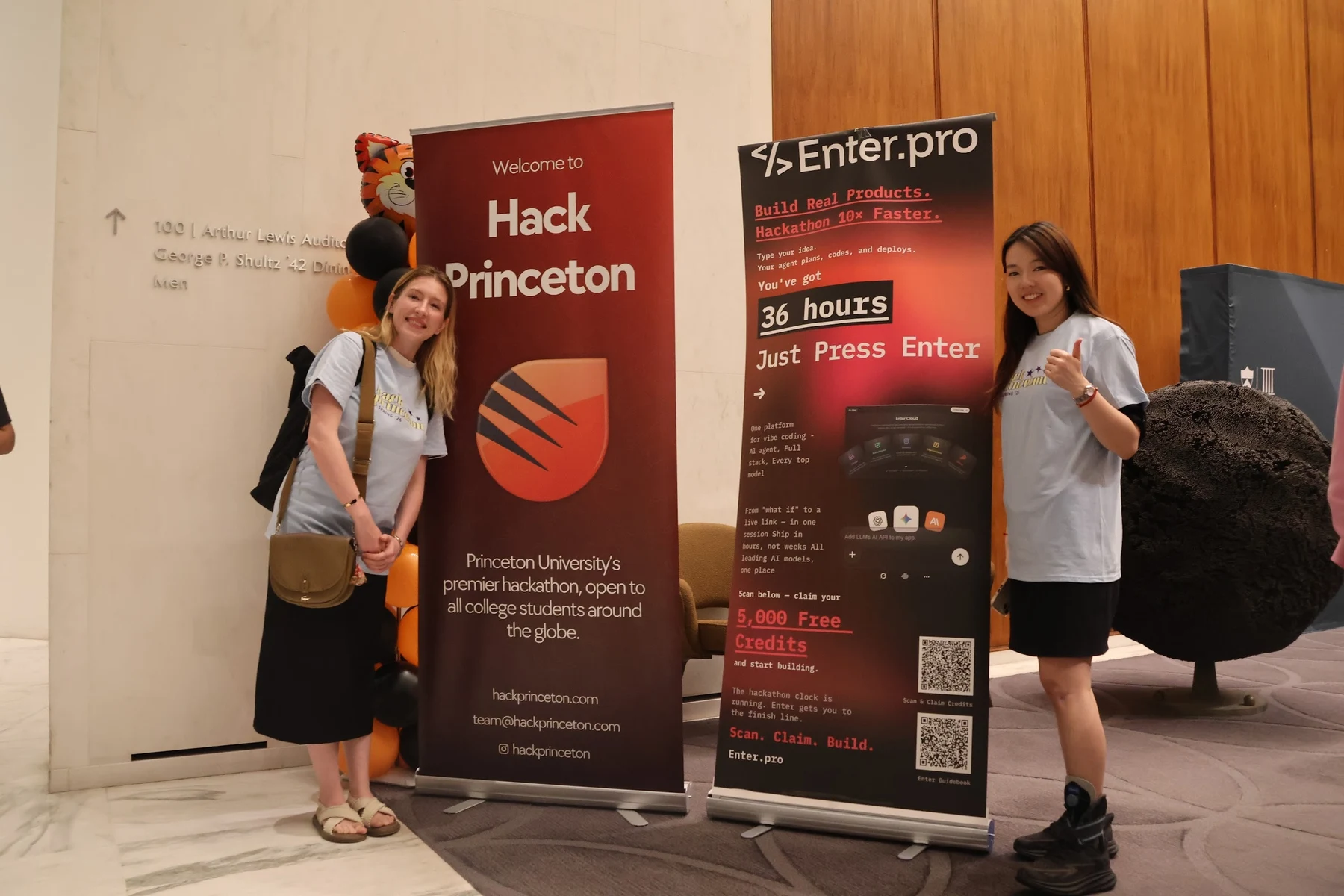
HackPrinceton Spring 2026 gave that thesis a concrete test. 105 participants. 38 projects. 36 hours at one of the most competitive academic institutions in the world. Converge AI attended as a sponsor, bringing Enter Pro — its AI-native development platform — to the floor. What the weekend produced was not just a set of impressive student projects. It was a concentrated dataset on where the next generation of builders is, what they care about, and what "building" actually means in 2026.
Three patterns emerged. Each one has implications that extend well beyond a weekend hackathon.
The Market Context That Shaped the Room
Before the first line of code was written at HackPrinceton, the numbers behind the room are worth stating explicitly.
AI absorbed 61% of all global venture capital in 2025 — not 20%, not 30%, 61. The last time any single technology category held that share of investment was the internet in 1999. The difference this time: this cycle has revenue, margin, and scaled deployment. The money is not chasing a promise. It is chasing a proven compounding.
The cost of intelligence has collapsed in parallel. What required $50,000 in compute three years ago runs for $50 today — a 500x price reduction, the fastest in the history of any technology category.

These numbers do not stay abstract for long. When intelligence becomes this cheap to access, the constraint on building shifts. Technical execution stops being the differentiator. The builders who arrived at HackPrinceton understood this intuitively — even if they would not have described it in those terms.
HackPrinceton: What the Format Reveals
Princeton University was founded in 1746. It has shaped American law, politics, science, and finance for nearly three centuries. The weight of the institution is part of the context — because what happened inside HackPrinceton is more interesting when you know where it happened.

HackPrinceton is student-run, held twice a year, and open to students beyond Princeton itself. The format is deliberately minimal: form a team, pick a problem, build something in 36 hours, demo it in two minutes. No lectures. No grades. No prescribed solution path.
This semester's five primary tracks covered Healthcare, Sustainability, Business & Enterprise, Entertainment & Media, and Education. Three wildcard categories — Best Hardware Hack, Best Game, and Best Rookie Hack — were added for teams working outside conventional categories or competing for the first time.
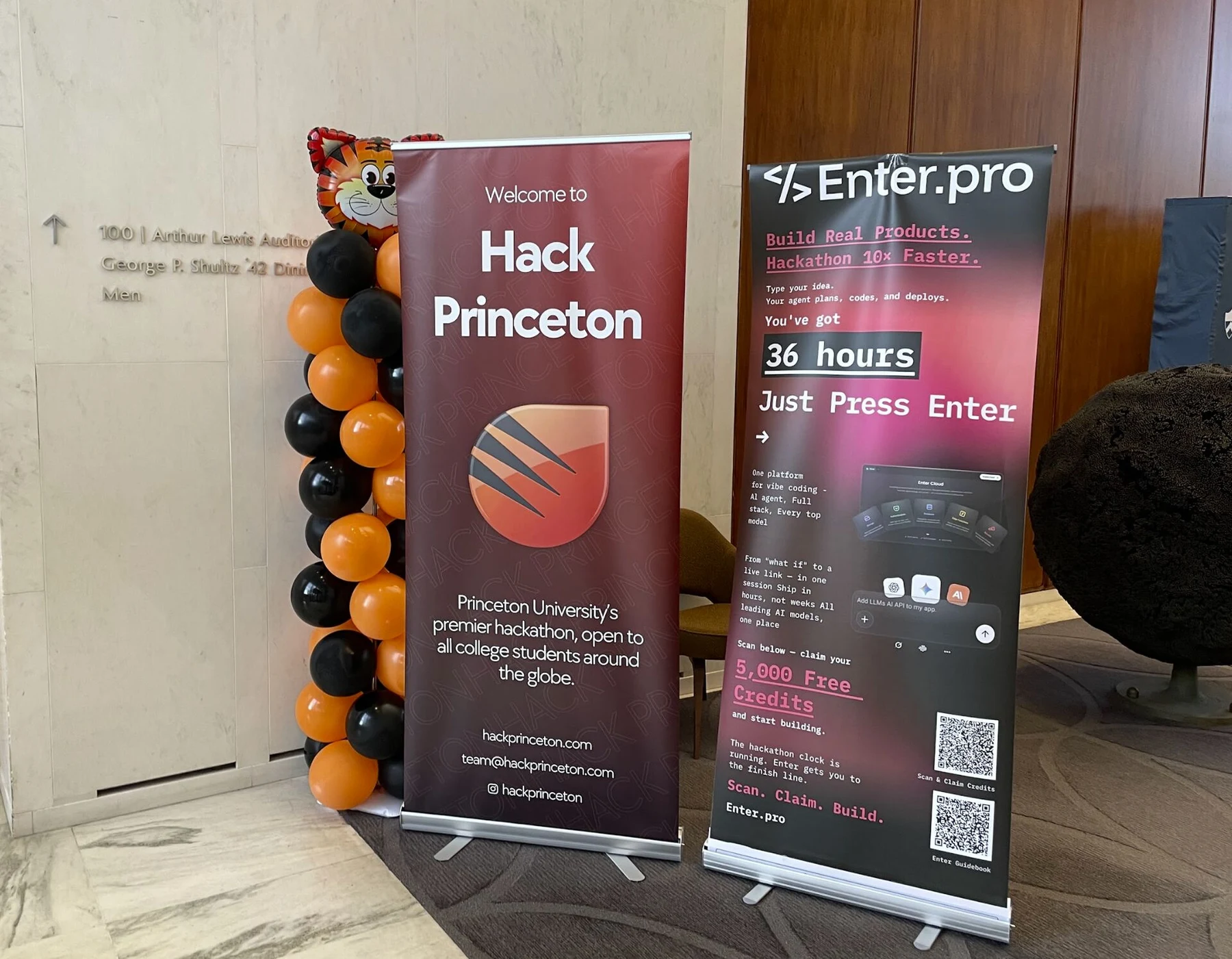
Without a prescribed solution path, builders default to the problems that genuinely bother them. That is the format's most important feature — and what makes a hackathon a more honest signal than most industry surveys.
Trend 1: The Gap Between Experienced Developers and First-Time Builders Is Closing
The clearest signal from HackPrinceton was not the winning project. It was the volume of teams who shipped something functional with no prior development experience — and the quality of what they produced.
"Best Rookie Hack" exists for builders who have never competed. What the weekend demonstrated is that "rookie" no longer means "limited output." Teams who arrived on Friday without a working prototype left Sunday with something live, documented, and functional.
This pattern is not specific to HackPrinceton. Across the AI development landscape, the barrier to entry has moved. The question is no longer "can I write the code?" It is "do I understand the problem well enough to build something useful for the people it affects?"
That shift is consequential for educators, hiring managers, investors, and any organization building products for this cohort. The credential that mattered last decade — technical proficiency — is becoming table stakes. The credential that is emerging — judgment about what to build and for whom — is harder to teach and harder to credential, but increasingly visible in what people actually ship.
Trend 2: Problem Selection Is the Core Differentiator — Not Execution
The workshop Converge AI ran at HackPrinceton — "Build Now or Catch Up Later" — covered seven industries being actively reshaped by AI: healthcare, sustainability, enterprise, entertainment, education, gaming, and hardware. The structural pattern across all seven was the same.
AI handles the structured, repetitive 80% of any domain's workload. The remaining 20% — judgment, taste, domain expertise, creative direction — remains human. That 80/20 distribution is stable across industries.
The practical consequence: in any product category where AI tools are accessible, execution is no longer a differentiator. What separates a product that survives is the quality of the problem it targets and the specificity of the customer it serves.
This reframe landed differently on different participants. Builders who arrived asking "what can I build with AI?" left with a harder question: "what problem is genuinely worth solving, and for whom?" The shift from capability to judgment is the most important transition the AI development ecosystem is still working out how to teach.
It is also the transition Converge AI built Enter Pro to serve. The platform is designed for builders who know what they want to build and need the infrastructure to move from idea to deployed product without being blocked by execution overhead.
Trend 3: The Next Generation of Builders Does Not Wait for Permission

At the Enter Pro sponsor booth, a Converge AI team member walks participants through the platform's capabilities. Builders arrived with problems already in mind — and evaluated tools against what they had already decided to ship.
At the opening ceremony, teams were still forming. The tracks had just been announced. The 36-hour clock had not started. But builders were already at sponsor tables, downloading tools, asking whether the platform could handle what they had already decided to build.
That behavior — arriving with a problem already defined, evaluating tools against that problem, moving before the official start — is a meaningful signal about how this cohort operates.
These builders are not looking for permission or a syllabus. They are looking for infrastructure that meets them where they are and removes the distance between what they imagine and what they can ship.
By Sunday morning, those same builders stood in front of judges with something real to show.

Competitors present completed projects at the Sunday judging session — working products built from scratch over 36 hours of continuous development.
Two Projects That Illustrate Where Serious Product Thinking Comes From
Vietnam Refugee Trail: Historical Education Built in 36 Hours by Three First-Generation Students
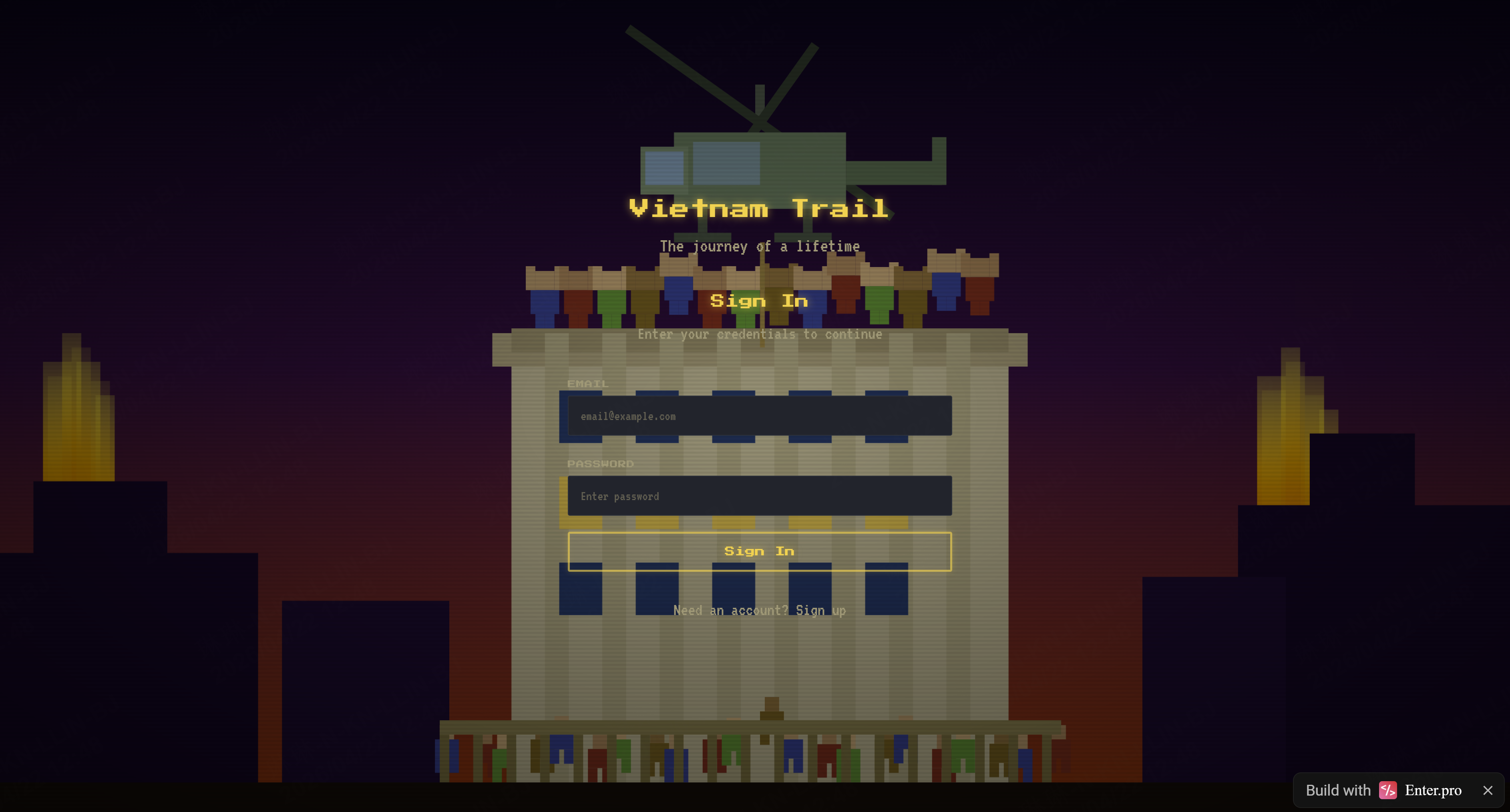
Try the game: https://www.we-are-saigone.us/auth
Vietnam Refugee Trail is a single-player educational game set after the Fall of Saigon in 1975. Players navigate the experience of a Vietnamese refugee attempting to leave the country — a journey in which one in three people did not survive. The format draws on Oregon Trail: familiar, accessible, designed for younger audiences encountering this history for the first time.
Three first-time builders. 36 hours. A fully working, emotionally considered, historically grounded product.
The team built on Enter Pro and described the experience directly:
"Enter.pro is responsible for allowing three rookies to build an extensive app in 36 hours."
What makes this project significant is not the technical achievement, though that is real. It is the problem the team chose. No one assigned it. No market research pointed to it. It came from lived experience and a belief that the story deserved to exist in a form that could reach younger audiences. The customer — any young person who will encounter this history through a game before they encounter it in a textbook — is large, underserved, and clearly defined.
Terra Zone AI: Environmental Due Diligence Compressed from Six Weeks to 60 Seconds By a cross-university team — Rutgers × Princeton
The problem that generated Terra Zone AI started at a career fair. A student spoke with environmental consulting recruiters who described their standard workflow: weeks of pulling geological surveys, cross-referencing zoning codes, and running foundation estimates — just to deliver a client a preliminary yes or no. Six weeks. $20,000. For a preliminary answer.
That inefficiency is not unique to environmental consulting. It is the standard model for any due diligence-heavy industry where data aggregation precedes every decision.
Terra Zone AI addresses it directly. A user draws a polygon on a map. In under 60 seconds, the platform aggregates geological data, municipal zoning codes, and construction APIs, runs a risk-adjusted financial model, and returns a GO / NO-GO / CONDITIONAL verdict with a full investment-grade breakdown.
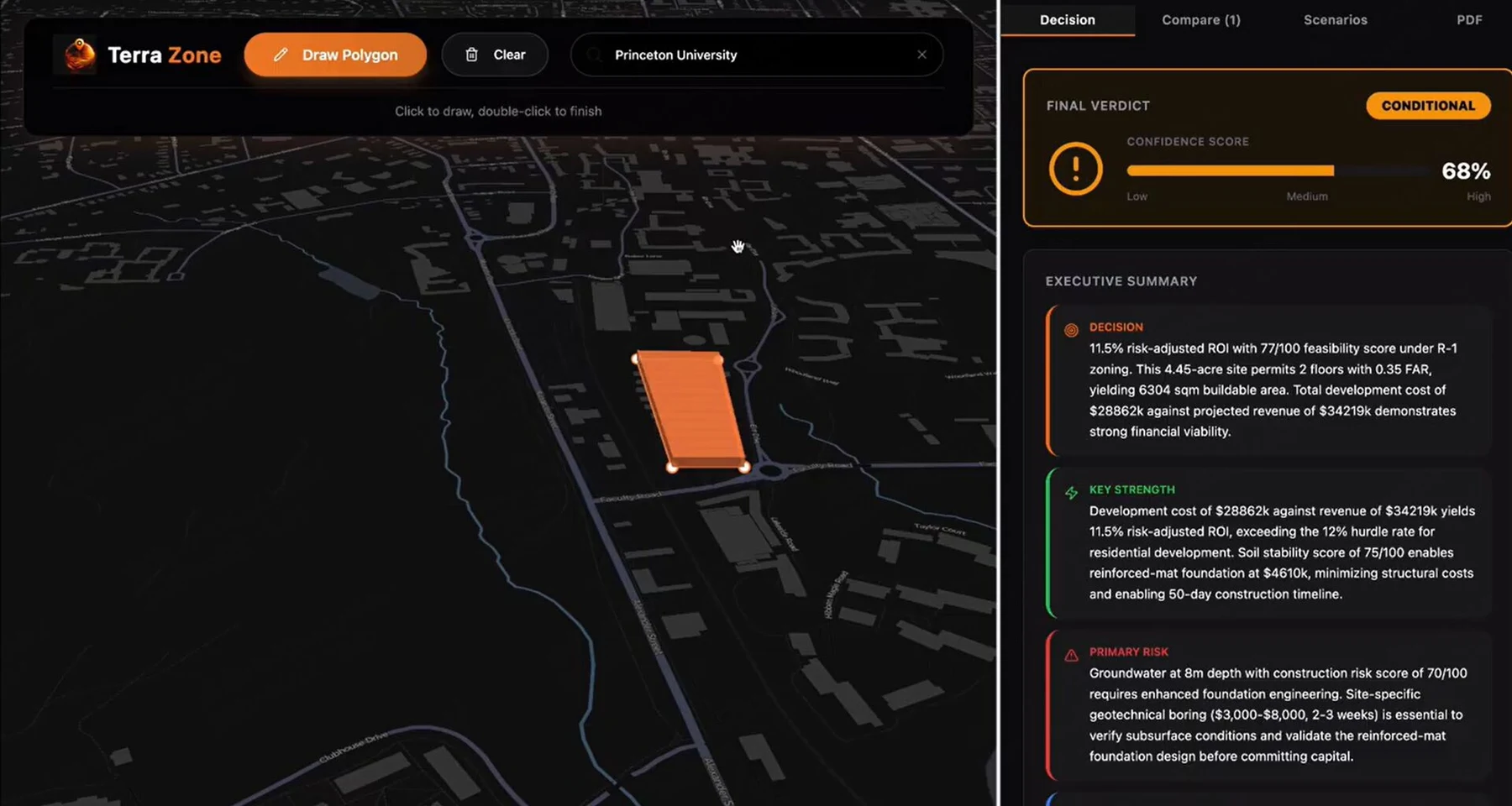
View the live build: https://c8dba0ffb8294fcfaa3cd6ee85f2761d.prod.enterapp.pro/
The team built a seven-layer fallback system so that if an external API fails or a model returns an unreliable output, the platform defaults to deterministic calculations. Clients never see a broken screen. That is not a feature. That is product judgment.
The $20,000 six-week engagement that environmental consultants currently charge is not the endpoint for that industry. It is the current state. Products like Terra Zone AI are what the transition looks like.
Best Use of Enter Pro: Five Teams Recognized at HackPrinceton
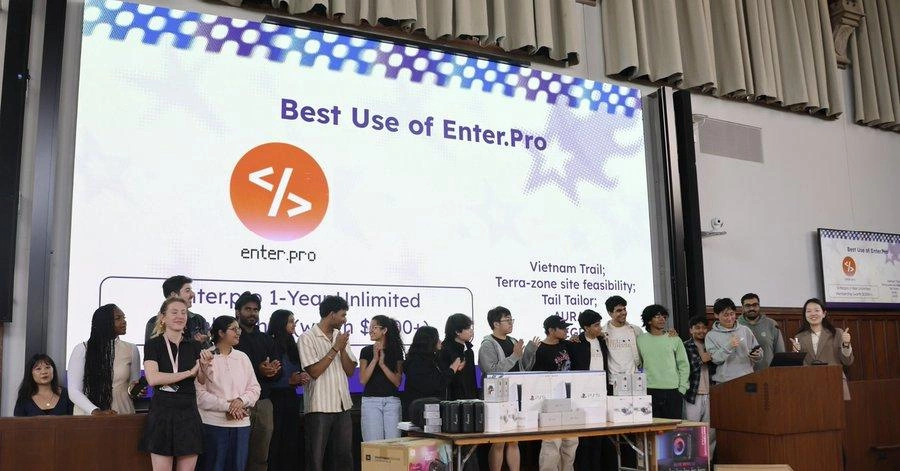
Converge AI presented a special "Best Use of Enter Pro" award at HackPrinceton — recognizing teams who used the platform to ship the most ambitious and complete products in 36 hours. Five teams were recognized, spanning educational games, environmental technology, fashion, and beyond.
The fact that five distinct teams, working independently across different industries, chose Enter Pro as the platform to build on — and that all five shipped something complete — is a more useful data point than any single project. It is a signal about what builders reach for when the clock is running and the stakes are real.
Key Takes Away from HackPrinceton
The 38 projects submitted at HackPrinceton represent a sample, not a survey. But samples this concentrated tend to surface real patterns early.
The surface pattern is clear: builders are no longer blocked by technical access. The constraint is judgment — the ability to identify a problem worth solving, understand who it affects, and ship something specific enough to work.
But there is a deeper pattern underneath. Every standout project at HackPrinceton was not built by a single person working in isolation. It was built by a small team whose members coordinated with AI to produce an output that would have required an organization many times their size a year ago. Three students delivered a historically grounded educational game. Two students delivered an enterprise-grade due diligence platform. The output per person is not increasing linearly. It is increasing by an order of magnitude.
This is what Converge AI is building toward. Not AI as a collection of disconnected tools — but intelligence as coordinated infrastructure, flowing across products, systems, and execution layers. The industrial revolution mechanized labor. The internet connected information. AI is now reaching an analogous inflection point: for the first time, intelligence itself can become operational infrastructure, capable of coordinating creation, execution, and outcomes at the team level.
Every business will become AI-native. Every workflow will become coordinated. Every team — including a team of three students at a 36-hour hackathon — will gain access to capabilities once limited to organizations with vastly greater resources.
Converge AI was founded on this belief. Enter Pro is its platform for builder intelligence: the layer where coordination between human judgment and AI execution begins. HackPrinceton Spring 2026 provided 105 builders and 38 shipped products as evidence of what becomes possible when that infrastructure is accessible and the friction disappears.
The builders who competed at Princeton are not waiting for the industry to catch up. The future belongs to specialized intelligences working in concert with the people who direct them. The question for the industry is whether the infrastructure being built today is ready to serve that future.
Converge AI is building the infrastructure for AI-native work — accelerating the transition to institutional intelligence across products, organizations, and execution layers. Enter Pro is its platform for builder intelligence.


